





Pain and Rehabilitation Center
Pain Rehabilitation Center
Rehabilitation after surgery clinic
Post-Surgical Rehabilitation Clinic
Fast, healthy recovery
begins with rehabilitation.
Led by rehabilitation medicine specialists trained at Severance Hospital,
we run a rehabilitation clinic dedicated to our patients' rapid recovery.
With active recovery treatment, return to daily life
quickly and safely.
ONE - Q SYSTEM
Post-operative rehabilitation
ONE-Q system
Under the collaborative care of a rehabilitation medicine specialist from Severance
and an experienced orthopedic specialist, a manual therapist with 30 years of experience
provides 1:1 customized rehabilitation.


Same-day testing → outpatient care → admission, from before surgery to after surgery, one-q, rehabilitation medicine, orthopedics, manual therapy
With expertise and sincerity,
our rehabilitation medicine specialists are with you.
A rehabilitation medicine specialist trained at Severance Hospitalof
makes a precise diagnosis, and on that basis
we provide personalized rehabilitation care at university hospital level.


Pain Rehabilitation Center
Shin Sang-hoon Center Director
Specialties
- Pre- and post-operative rehabilitation / sarcopenia / vestibular rehabilitation / sports rehabilitation
Experience
- Graduated from Chung-Ang University College of Medicine
- Intern, Severance Hospital
- Resident, Department of Rehabilitation Medicine, Severance Hospital
- Clinical Fellow, Department of Rehabilitation Medicine, Gangnam Severance Hospital
- Supervising Specialist, Department of Rehabilitation Medicine, Yonsei University College of Medicine
Academic Societies
- Full member, Korean Academy of Rehabilitation Medicine
- Full member, Korean Association of Clinical Pain
- Full member, Korean Society for Neurorehabilitation
- Full member, Korean Spinal Cord Society
- Full member, Korean Society of Cancer Rehabilitation
- Full member, Korean Academy of Geriatric Rehabilitation Medicine
- Full member, Korean Society of Sports Medicine
Ongoing research on post-operative rehabilitation
Precise rehabilitation and recovery completed with meticulous care.
We keep researching today to add depth to it.
-

Therapeutic effect of a new hydraulic distension
technique in patients with frozen shoulder
Clinical Pain (2018) -

Effect of stretch-and-spray therapy using a pumping technique
on frozen shoulder: a retrospective case-control comparative
study including 6-month follow-up
Pain Physician (2019) -

Duloxetine treatment for uncontrollable
laughter after stroke: a case report
Clinical Neuropharmacology (2019) -

A new treatment approach for improving gait speed
in patients with spastic paraplegia
BMJ Supportive & Palliative Care (2020) -

Effect of intramuscular electrical stimulation
on relieving nociceptive pain
after (open) pancreaticoduodenectomy: a clinical study
American College of Surgeons (2020) -

In elderly patients after spinal surgery:
the effect of exoskeleton wearable robot gait training
Geriatric Rehabilitation (2023) -

Correlation between the size of ossification of the posterior longitudinal ligament
and the severity of multifidus fatty degeneration at each spinal segment
Neurospine (2023) -

Following COVID-19 lockdown and vertebral compression fracture,
caused by reduced physical activity and
mistaken for sarcopenia:
normal pressure hydrocephalus - a case report
Geriatric Rehabilitation (2024) -

Validation of a five-times sit-to-stand test device:
comparison of plantar pressure and
head movement analysis with manual measurement
Yonsei Medical Journal (2024) -

A new protocol for early robotic gait
rehabilitation after spinal surgery
Frontiers in Medicine (2024)
BEST REVIEW
The attentive care of our medical staff
makes a different result!
Beyond simple treatment, the quality of life of every single patient is what we care about
Kwangdong Hospital's care philosophy
is reflected in countless patient reviews.
Honest treatment reviews from those who experienced it firsthand -
see them now!


Recovery after surgery
begins with rehabilitation.
When functional decline caused by disease, injury or surgery
is not properly addressed, chronic pain, muscle weakness, limited movement and other
secondary problems can follow.
For a complete recovery, therefore,
systematic rehabilitation in the early stage is extremely important.
-

 01
Patients with musculoskeletal injuries
Those with fractures, dislocations, ligament injuries or sports injuries
that restrict physical activity -

 02
Decline in physical function due to aging
Older adults whose movement is limited by muscle weakness,
reduced balance and decreased joint function -

 03
Patients with chronic pain
Patients with chronic low back pain, neck pain, shoulder pain or similar problems
who experience discomfort in daily life -

 04
Pre-operative / post-operative patients
Joint replacement surgery, spinal surgery and other
musculoskeletal surgery
Best Process
Step-by-step program for post-surgical rehabilitation
Even after a good surgical result, without rehabilitation
the condition can recur, and
if soft tissue was damaged during surgery,
it has to be treated and the weakened muscles, bones, nerves and
other internal structures have to be strengthened.
-

 Step 1
Assessment & goal setting
- The medical team assesses the patient's physical function,
pain level, range of motion, muscle strength and more
comprehensively, and
sets the goals of rehabilitation
- The medical team assesses the patient's physical function,
-

 Step 2
Treatment plan
- Taking each patient's condition, age, sex,
lifestyle habits and more into overall account,
and to maximize recovery, we establish
a 1:1 customized rehabilitation plan
- Taking each patient's condition, age, sex,
-

 Step 3
Step-by-step rehabilitation
- Relieving pain and inflammation,
starting with early treatment and building muscle strength,
improving flexibility, and restoring physical function:
a step-by-step program is carried out
- Relieving pain and inflammation,
-

 Step 4
Self-management guidance
- So that even after rehabilitation ends, patients can
maintain their improved physical function on their own
and prevent after-effects and recurrence,
we provide guidance on self-management
- So that even after rehabilitation ends, patients can
Patients recommended for treatment
Who the Post-Surgical Rehabilitation Clinic is for
If even one of the following applies to you,
consider post-surgical rehabilitation.
Checklist


-
Those with a lumbar or cervical disc problem, stenosis or similar condition
who have had spinal surgery -
Those with shoulder, knee, hip or other
joint surgery -
Those who still have pain after surgery
-
Those with limited mobility after surgery
who need intensive rehabilitation
Who needs this -
Those who need to recover spinal and joint range of motion
and muscle strength after surgery
Who needs this -
Athletes who, after musculoskeletal surgery,
want to return to sport quickly
Program
Main treatment programs for post-surgical rehabilitation
Matched to the direction and intensity of rehabilitation,
we provide systematic, customized rehabilitation

-

- 01. Exercise Therapy
- Exercise Therapy
Mats, Thera-Bands, balance pads, gym balls and more:
a variety of rehabilitation tools are usedPersonalized (tailored to age, occupation (athlete, etc.) and type of surgery)
It stimulates muscles you do not normally use to improve postural alignment,
and improves spinal and joint stability and muscle strength to create normal movement,
which can be expected to help prevent recurrence. -

- 02. Manual Therapy
- Manual Therapy
The therapist treats with their hands rather than machines,
with careful precisionIt restores mobility to stiffened joints and relaxes the fascia
to reduce pain, and corrects the alignment and balance of the spine, joints and muscles
to normalize function. -

- 03. Extracorporeal Shockwave Therapy
- Extracorporal Shock Wave Therapy
Two types of
shockwave treatment are providedIt delivers high-pressure shockwaves to the injured area to relieve pain,
increases blood flow to help damaged tissue regenerate faster,
and is an outstanding treatment for releasing muscle stiffness and improving flexibility. -

- 04. IMS
- Muscle and nerve stimulation therapy
Stabilizing hypersensitive nerves
with needlesIMS treatment uses special needles and injections at set points around the muscles and nerves
to relax knotted muscles and normalize the function of
nerves that have become hypersensitive. -

- 05. Injection Therapy
- Injection Therapy
Reducing pain or
promoting regenerationThis is an injection treatment that helps tissue heal on its own.
As the damaged ligament regenerates, it firmly supports the bone and joint again, allowing treatment that relieves pain and also lowers the likelihood of recurrence. -

- 06. Neurocryostimulation
- Neurocryostimulation
Surgical site inflammation:
rapid improvementIt applies cold stimulation to the surgical site to constrict the blood vessels,
blocks the action of pain-triggering nerve fibers to relieve pain,
and reduces swelling, hematoma and inflammation to enhance the treatment effect. -

- 07. Inpatient Treatment
- Hospitalization
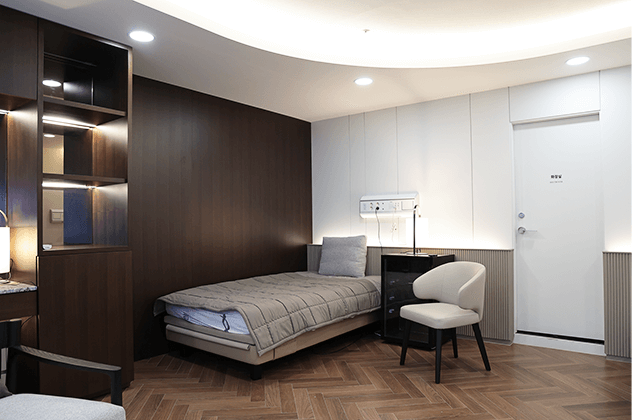
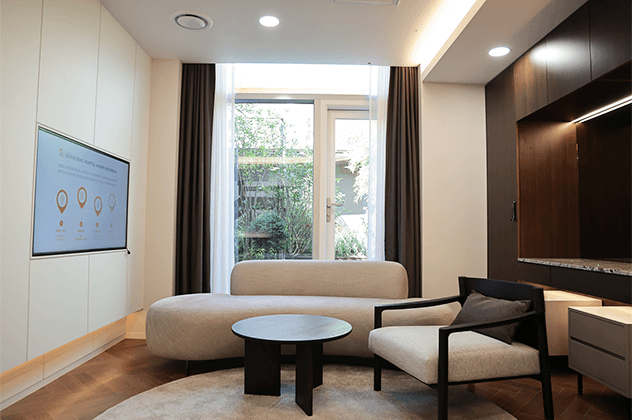
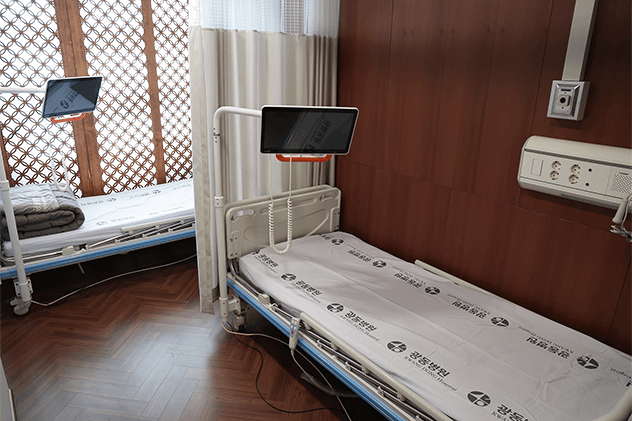
Premium single rooms,
multi-bed rooms (2~3 beds)For those who, before or after surgery, have spinal and joint pain and functional decline
and experience discomfort in daily life,
we operate an inpatient treatment program where you can receive
specialized rehabilitation therapy and intensive care.
Kwangdong Hospitalization
Guide to the pre- and post-surgical rehabilitation inpatient facilities
Kwangdong Hospital, for your rapid recovery and
comfortable stay, provides a pleasant treatment environment.
With clean inpatient rooms, professional nursing staff and
the care of a customized rehabilitation team, we will help you return to a healthy daily life.

Pre-surgical rehabilitation:
the start of a faster recovery.
If you are thinking about preventing side effects as well as recovering,
pre-surgical rehabilitation is the answer.
Expected effects after pre-surgical rehabilitation
Muscle strength
Strengthening
Flexibility
Improvement
Cardiopulmonary function
Improvement
Side effects
Prevention
Surgical pain
Reduction
Recovery speed
Improvement


Kwangdong Hospital Prevention & Vaccine Rehabilitation Solution
Pre- and Post-Surgical Rehabilitation Clinic
3 STEP rehabilitation
Rather than concentrating treatment only on
the 'specific period after onset' that is the usual timing of conventional rehabilitation,
we also focus on 'pre-onset stage rehabilitation (Prehabilitation)' and
'post-treatment stage rehabilitation (Post-Rehabilitation)'.


Question
Frequently asked questions about pre- and post-surgical rehabilitation
- Q1.
- When can I start rehabilitation after surgery?

- The sooner, the better.
However, the starting point can differ depending on the surgical site and the type of surgery, so it is important to follow your attending doctor's advice.
- Q2.
- Should I exercise even when it hurts? Won't it strain the surgical site?
- Under the guidance of specialist medical staff, rehabilitation is
safely designed so that it does not strain the surgical site.
In fact, appropriate movement helps recovery.
- Q3.
- How long do I need rehabilitation after surgery?
- The length of treatment differs depending on the type of surgery and the patient's rate of recovery.
After simple surgery a few weeks of rehabilitation is enough, but when recovery takes longer, as with joint or spinal surgery, several months or more of rehabilitation may be needed.
- Q4.
- What problems can arise if I do not have rehabilitation?
- If it is left without rehabilitation, the muscles weaken or the joints stiffen,
which can delay your return to daily life.
In severe cases, the operated area may not function properly.
- Q5.
- Is rehabilitation before surgery really necessary?
- Rehabilitation before surgery is a great help in improving the surgical result and speeding up recovery.
By strengthening the muscles and improving joint movement, it helps you return to daily life more quickly even after surgery.
- Q6.
- How does pre-surgical rehabilitation affect the surgical result?
- Patients who have rehabilitation before surgery recover faster afterwards, have less pain, and have a lower rate of complications.
In particular, it also has a positive effect on joint range of motion and functional recovery.